Key Takeaways
As global sustainability regulations tighten, vague environmental claims no longer earn market credibility. Giant Group has moved from broad green messaging to a science-based, verifiable disclosure system anchored by one tangible output: the Product Carbon Footprint ID (PCF ID) — powered by an SGS-certified Product Carbon Footprint Calculation Platform developed in-house at Giant Group's Taiwan manufacturing facility. At the 2026 Taipei Cycle Show, Giant Group disclosed the calculated carbon footprints of 12 key bicycle models across Giant, Liv, and Momentum, and publicly unveiled the PCF ID concept — a physical folded card designed to accompany each bicycle once rollout begins, presenting its full cradle-to-grave footprint in a clear, readable format that answers a question the industry has long left unanswered: what is the actual carbon footprint of the bicycle you ride?
Why the PCF ID Matters Now: Closing the Gap Between Green Claims and Verifiable Data
For decades, the global manufacturing sector has relied on industry averages and high-level estimates to communicate environmental impact. That era is ending. International regimes — notably the EU’s CBAM and CSRD — and rising demands from Tier 1 investors and B2B partners for granular product-level transparency are reshaping the bicycle industry.
Giant Group began preparing for this shift years ago. Between 2020 and 2024, the Group completed full cradle-to-grave Life Cycle Assessments (LCAs) on six bicycle models, building a proprietary emission factor database specific to its materials, processes, and supplier network. The five stages of a product’s life — materials acquisition, manufacturing, transportation and distribution, product usage, and disposal — are each rigorously measured and accounted for under this methodology. This internal database became the foundation for the Product Carbon Footprint Calculation Platform, developed in-house at Giant Group's Taiwan manufacturing facility.
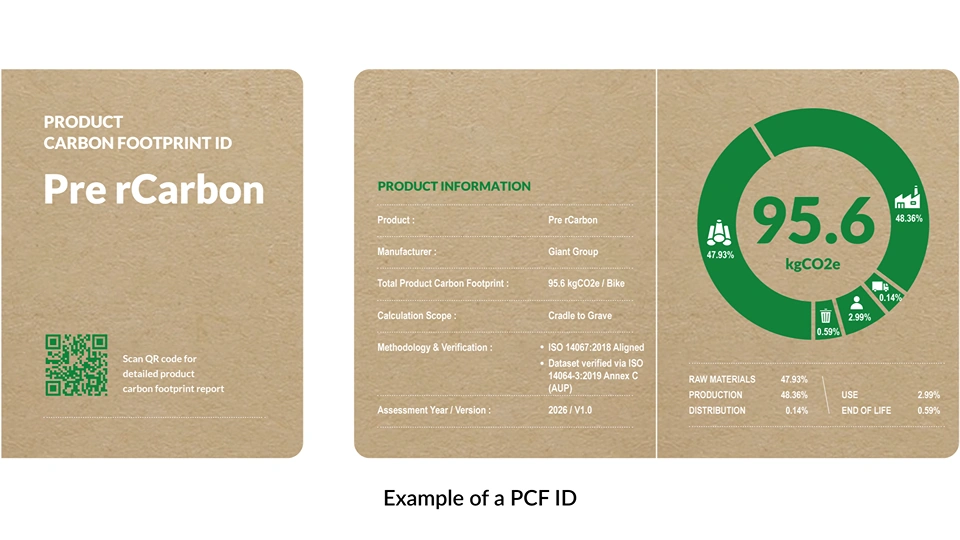
The PCF ID is the visible result of this work. While calculation systems are emerging across the industry, Giant Group is distinct in its plan to translate LCA-calculated data into a tangible, product-attached identity: a physical folded card designed to accompany each bicycle — readable by riders, meaningful to partners, and credible to regulators. The Calculation Platform is the foundation; the PCF ID is the planned deliverable.
Carbon Transparency,
engineered in-house
The Engineering Behind the PCF ID
Giant Group’s calculation platform draws on internationally recognized emission factor databases combined with primary activity data collected from its own operations and supplier network. The result is carbon data that is more granular, accurate, and traceable than third-party estimates alone.
This precision is enabled by Giant Group’s structural advantages: deep operational control over its own manufacturing processes and comprehensive LCA mapping across all five product lifecycle stages for in-scope models. The platform can complete a full product carbon calculation in as little as 10 minutes, today covers approximately 35% of the Group's product lines — all produced at the Taiwan manufacturing facility — and adheres to ISO 14067, the international standard for product carbon footprinting. The platform itself has successfully passed Agreed-Upon Procedures (AUP) verification conducted by SGS, a globally recognized third-party certification body.
Beyond compliance, the platform is intended to equip Giant Group's engineering organization with a capability the industry has largely lacked: the ability to integrate carbon data into the earliest stages of product design. By identifying high-emission lifecycle stages before a model reaches mass production, engineers will be able to evaluate material and process alternatives — for example, quantifying the environmental benefit of substituting recycled aluminium or other recycled materials for traditional petrochemical options. This is the direction Giant Group's engineering function is building toward, and the platform is the foundation that makes it possible.
What the PCF ID Delivers: From Disclosure to Decision
At the 2026 Taipei Cycle Show, Giant Group publicly disclosed cradle-to-grave carbon footprints for 12 key models from across its multi-brand portfolio — Giant, Liv, and Momentum — and unveiled the PCF ID for the first time, using the PRE rCARBON as the showcase example.
The PCF ID is not an eco-claim. It is a product-level carbon disclosure — presenting a bicycle's full cradle-to-grave footprint in a clear, physical format designed to accompany the product. For B2B partners and investors, it strengthens regulatory readiness as CBAM enforcement advances and CSRD raises the bar on product-level disclosure. For consumers, it provides something previously unavailable: a clear, credible answer to what their purchase means in carbon terms.
Giant Group’s Taiwan manufacturing facility is building this capability today, with a roadmap to gradually extend it across all product categories within the Group — protecting long-term market access and strengthening supply chain resilience.
The Road Ahead
Giant Group is not just building better bicycles. Through rigorous Life Cycle Assessment, an SGS-certified in-house Calculation Platform built to ISO 14067, and a physical carbon identity designed to accompany directly to each production bicycle, the Group is building the foundation for a measurable, sustainable future in global mobility.
As rollout extends, every PCF ID will travel with a bicycle — enabling clearer choices, more confident rides, and a deeper understanding of the impact behind every product.


A Measurable Commitment to Green Mobility